
Radical training
Radical elevates training costs to an investment in productivity.
Radical - BAD Outline.pdf > download...
“BAD” - Business Analyst Development Workshop
 People attending this Workshop should ideally have a knowledge of the techniques taught on the Systems Development (SAD) Workshop. A few selected skills and techniques taught on that Workshop are briefly reviewed by way of a refresher, but the rest of the techniques taught on the Systems Development Workshop remain the basic ‘building blocks’ of an Analyst
This Workshop takes the Business Analyst to the next level of professionalism. Having been equipped with the basic ‘tools of the trade’ on the SAD Workshop and having gained some practical experience in that field, the Analyst is now ready to get involved in higher level Business Analysis activities
As with the SAD Workshop, a lot of practical work is involved, mostly in teams, but there are also individual assignments.
We cover a number of techniques that would typically be done as stand-alone courses, so the total package is most cost-effective
-
Subjects covered in true Workshop style: Theory, followed by practical work with feedback on performance and the provision of templates that can be used ‘on the job’
-
Profile of a Business Analyst – responsibilities and skill requirements. A discussion on the IIBA, certification requirements and FAQ will be included during this session - Feasibility Study and Business Case development
- “Refresher” of the basic tools taught on the Systems Development Workshop, especially Data Flow Diagrams, Data gathering, Documentation and Entity Relationship Diagrams
- Facilitating skills in the Business Analysis area. Each person gets many opportunities to facilitate, receive feedback on performance and improve their skills
- JAD (Joint Applications Development). A number of practical sessions are conducted, with everyone participating
- Use case development, Business Process Modelling and Business Specifications. This includes the basic principles of Object Orientation. Detailed templates are provided. Use cases is the best way to ensure that all user requirements are elicited and at the same time to construct test cases
- Team building techniques
- Change management
- Mentoring. What it is, how to do it and how to implement a mentoring program
- Project Management. The basic techniques from a Business Analyst’s perspective
- Strategic Planning. The technique and how to apply it. Each team works on a different case study and the case studies have specifically been designed to provide a variety of organisations, so that delegates can see the system in operation in a variety of environments. They attend each other’s presentations.
- Business Writing Skills
- Business presentation skills
- Problem Solving Techniques
- Decision Analysis
- Testing – the methodology and supporting techniques. This focuses more on how to manage and implement the Testing process than doing the actual testing.
- Accelerated Learning and personal development. There is a strong emphasis on the development of the individual. Finding your direction with a personal strategic plan
- Reading skills – we teach delegates how to absorb a large quantity of information and quickly extract the main points and summarise them and we do this at the hand of a number of practical exercises
- Mind Maps – we teach this excellent technique and it is used throughout to show people how to shorten meetings, manage Projects and make many other day-to-day tasks easier and faster. This aspect has made significant impacts on many people and organisations that we have trained
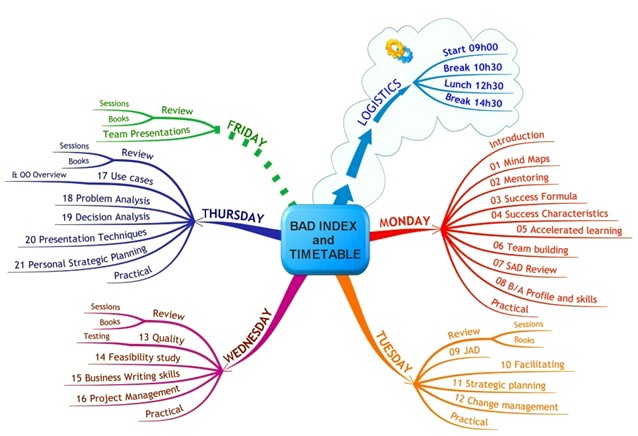
Duration: Monday to Friday full days using Microsoft Teams
Mind Map summary of course on next page
Radical - SDW Outline.pdf > download...
SAD Workshop – Systems Analysis and Design Workshop
Sound Business Solutions!
This is the ultimate aim of the Systems Developer. But those kinds of solutions do not happen by accident, which is why we recommend that you learn the Tools, Techniques and Methods which will consistently produce those results and we have the Workshop that achieves exactly that. The focus is on Business Analysis and we follow the principles that are contained in the IIBA Business Analysis Body of Knowledge
What can you hope to learn on this workshop?
The entire Information Engineering life Cycle is covered in true "Workshop" style, with delegates working in teams on practical case studies
Method of Tuition:
- Theory with examples in the classroom
- Practical work with lecturer support in teams
- On-going feedback on performance
-
The Structured approach to Systems Development, including the life cycle and particularly AGILE - Standards – how to set and maintain standards in all aspects of systems work
- Interviewing Strategy and Planning. Practical interviews are conducted and feedback on performance given. Interviews also have to be recorded on templates provided
- Requirements gathering – A number of techniques, including interviewing (above) are taught and applied during practical sessions. Understanding, recording and communicating the Business requirements via a BRD (Business Requirements Document) is covered
- The Human Interface - there is a strong emphasis on inter-personal skills
- Structured Documentation methods. Templates are provided and the structured methods taught have to be applied in each team, with feedback given on results
- Data Flow Diagrams – the theory supported by many practical sessions, covering the entire spectrum from Context Diagram right through to mini-specification (pseudo code) level
- Use Case development, with templates provided
- Logical Systems Modelling – how to get from the ‘as is’ to the ‘to be’ without perpetuating the problems inherent in the existing system
- Business Process Modelling
- Outline Design, using diagramming methods followed up with practical sessions in teams
- Maintenance and enhancements to existing systems – how to use the techniques taught to facilitate these activities that are frequently the cause of problems
- Entity Modelling and file design (Relational Data Analysis). Taught at the hand of case studies, followed up by practical work in teams with feedback on performance
- Object Orientation – brief overview and comparison
- Cost/Benefit Analysis techniques – teams have to prepare a cost/benefit analysis and present their results
- JAD (Joint Applications Development) – overview of the essential ingredients
- Structured Walkthroughs – the techniques are taught, followed up by practical structured walkthroughs, with feedback on performance
- Presentations – the theory and then each person in each team participate in a management presentation, with feedback provided on performance
- Quality Assurance techniques – some of the main techniques are taught and put into practice during practical team sessions, with feedback on performance
An intensive, five-day Workshop covering the Systems Development Life Cycle. The typical target audience would be business people who want to make their mark in the business analysis field and technical people who are moving into analysis and design.
Radical - OOUML Outline.pdf > download...
SAD UML Workshop
SAD Workshop using Object Oriented and UML(Unified Modeling Lanuage) life cycle and diagramming techniques
Sound Business Solutions!
This is the ultimate aim of the Business Analyst. But those kinds of solutions do not happen by accident, which is why we recommend that you learn the tools, techniques and methods which will consistently produce those results and we have the Workshop that achieves exactly that. Many organisations in South Africa and in a number of other countries have adopted the ‘best practice’ methods that we teach.
What can you hope to learn on this workshop?
The entire UML Road Map is covered in true Workshop style, with delegates working in teams on practical case studies. Their aim for the week is in fact to produce a Sound Business Solution for the main Case Study, which is a mortgage lending system. Radical believes that sound theory can only be effective once it is put into practice, hence our approach of learn, implement, review and practice
Method of Tuition:
- Theory with examples in the classroom
- Practical work with lecturer support in teams
- On-going feedback on performance
-
The main topics covered:
- UML Road Map is covered step by step as shown in the timetable at the end of this document
- Agile / Incremental and other systems development life cycles. Agile techniques are used during the Workshop
- Use Cases – how to find and document them – templates are provided
- Class model – how to discover classes and devise a class model
- Standards – how to set and maintain standards in all aspects of systems work
- Interviewing Strategy and Planning. Practical interviews are conducted and feedback on performance given. Interviews also have to be recorded on templates provided and here feedback on performance is also given to each person. There is a strong emphasis on the ‘human interface’ throughout
- Requirements gathering – A number of techniques, including interviewing (above) are taught and applied during practical sessions. Ensuring that requirements are clearly understood and stated in ‘testable terms’. A BRD (Business Requirements Description) template is used during the Workshop, as well as the extensive use of Use Cases
- UML Documentation methods. Templates are provided and the methods taught have to be applied in each team, with feedback given on results
- A variety of diagramming tools are taught, starting with Data Flow Diagrams and Entity relationship diagrams for documenting existing ‘as is’ legacy systems and then the entire spectrum of UML diagrams as shown in the curriculum below
- Logical Systems Modelling – how to get from the ‘as is’ to the ‘to be’ without perpetuating the problems inherent in the existing system
- Business Process Modelling and Business Process Re-engineering is the on-going theme throughout this Workshop
- Structured Walkthroughs – the techniques are taught, followed up by practical structured walkthroughs, with feedback on performance. The purpose here is to improve the quality
- Structured Walkthroughs – the theory and then each person in each team participate in a structured walkthrough, with feedback provided on performance
- Quality Assurance techniques – some of the main techniques are taught and put into practice during practical team sessions, with feedback on performance
- The entire spectrum of Systems Development in the OO world and specifically the UML from high to low level, to give delegates a sound understanding of the logic behind these approaches
An intensive, five-day Workshop. The typical target audience would be business analysts who are moving into the Object Oriented (UML) areas and who want to improve their professionalism, business people who want to understand the concepts contained in the UML approach and technical people who are moving into analysis and design in the UML field.
SAD UML timetable
Monday- Workshop Introduction and Overview
- Methodologies comparison – Waterfall, RAD, Agile, Incremental, UML
- Analysing the ‘as is’
- Information Gathering Skills overview
- Traditional Functional Analysis techniques overview – Business Process Flows, Data Flow and Entity Relationship Diagrams, to understand the existing system
- Practical: Constructing a model of the existing system, which is based on relational theory. A sample solution is provided.
- Review of techniques taught yesterday
- Object Orientation fundamentals and definitions of terms
- The OO approach – a step-by-step procedure
- What and why UML?
- Use cases in action
- ‘Object Think’ and CRC (Class, Responsibility, Collaboration) Cards
- Practical: Developing Use Cases and starting the class model
- The key OO Models, with practical exercises
- Analysis and Design in an OO World
-
Practical:
- Developing the OO models for the proposed system
- Testing your understanding of OO
- Discussion of solutions to practical exercises
- OO issues and concerns and how to really mess it up
- Practical: Finalising the proposed systems design: Class model, use cases, sequence diagrams, business process diagrams, state diagrams
- Structured Walkthrough of proposed system per UML road map
Radical - Personal Strategic Planning and Development Workshop Outline.pdf > download...
Personal Strategic Planning and Development Workshop
“If you don’t know where you’re going any road will take you there”. A well-known saying, but setting and achieving your personal direction is often easier said than done. The focus of this Workshop is to provide each delegate with a clear, step-by-step method. We discuss each step and it is then up to each delegate to continue with the process afterwards. The benefit is that an easy to follow template is used to guide you.
The main topics covered in Workshop style:- The ultimate success formula
- The ingredients of success
- The need to have a plan - key future trends
- Anchoring techniques
- Where are you going? You will learn how to draw up your personal strategic plan
- How to communicate with yourself and change perceptions
- How to take charge of your life instead of being tossed about like a leaf in the wind
- Your day-by-day steps to personal excellence
- Mind-Maps: How to draw and use them to help you plan
-
You will have started drawing up a workable personal strategic plan, which you can put to work straight away. Part of your post-course work is to complete and implement this plan. A structured and easy to follow method is used and you also receive a draft to guide you.
The main sections of the template are covered by way of searching questions:- Who am I? What is identity, where does it come from and how does it change over time? If you have never written a mission statement for yourself then this portion alone has the power to change your life
- Where am I now? Unless you know where you are now, you are going nowhere. In fact, you already have all it takes to succeed. In this section you take an honest, in-depth look at yourself and take stock
- Where do I want to go? Not an easy question to answer! Building on the previous steps, we first address our immediate concerns and then, consider the question “what would I do if I knew I could not fail?”
- How am I going to get there? It is all very well having dreams and goals, but unless you plan and implement the day-to-day, easy to achieve and manageable steps, your chances of getting there are about zero
- What are the rules? If you don’t know what your personal values are, and have not ranked them in order of importance to you personally, you will constantly sabotage your own efforts. Values are the ultimate decision-making tool and the most powerful basis for rapport
- Systems Analysis & Design Workshop – Build robust, scalable solutions.
Radical - Personal Strategic Planning and Development Workshop Outline.pdf > download...
Radical - Project Management Workshop Outline.pdf > download...
Project Management Workshop
Despite the fact that many project management tools and techniques are available, projects still fail with monotonous regularity - why? The basic principles of project management and the critical success factors to make a project work are frequently ignored. These are the aspects that are covered in workshop style.
The manual that is provided contains templates and grids that can be put to practical use straight away.
This course is not ‘tool-specific’ as we believe that a clear understanding of the generic principles and techniques of project management will enable a project manager to ‘manage projects’ and the tools that are available are then assigned to their rightful place as ‘tools - not rules’. In this way the situation of the ‘tail wagging the dog’ with a complicated project management tool can be eliminated.
The notes that are provided are clearly indexed and referenced to facilitate subsequent ‘look-ups’ of specific material.
-
Introduction
- The project management culture
- Trends that show how important project management is becoming
- Definitions to achieve a common understanding of terminology
- Benefits to be derived from project management
- The status quo
- Project Characteristics and Phases
- Hard skills and soft skills
-
Organisational Structures
- How to manage projects successfully within different structures
- Vertical versus horizontal reporting lines and how to handle it
- The matrix structure
-
The Project Manager
- Skills and characteristics required
- Ethics and performance criteria
-
Teambuilding and Group Dynamics
- This section in the notes constitutes a workbook that can be used in many team situations, also identifying and using behavioural styles in project teams
-
Communication
- Written and verbal
- Meetings
-
Conflict
- Types of conflict
- Conflict handling methods
-
Time Management
- Simple yet effective ways to take control of this scarce resource in the project management arena
-
Quality
- The seven-step plan to quality
- Using JAD, Structured walkthroughs and testing techniques
-
Documentation
- How to set up and maintain a project file and also how to record information
-
Roles and Responsibilities
- The role and job description of each and every player, from Sponsor to one-time JAD attendee. How not to leave ANYTHING to chance.
Radical - Project Management Workshop Outline.pdf > download...
Radical - Testing Workshop Outline.pdf > download...
Software Testing Workshop
Various studies have shown that testing is the most time-consuming aspect of systems development and it is one that cannot be avoided. Despite this, testing receives little or no formal attention and training. The point is made in study after study that...........
Testing has the greatest potential for improving delivered quality
The little training that is available emphasises all of this and usually offers somewhat academic solutions.
We live by our motto that it is RESULTS that count and we have been studying information both locally and abroad. We have compiled a testing workshop with comprehensive documentation that can be put to use straight away in your Organisation.
Practical case study work in teams with reviews ensures that delegates are empowered to put the techniques taught to practical use.
- People, quality and the motivation to test. Giving each individual practical ways in which they can do it better immediately
- The testing paradox
- Feasibility Study and risk analysis as testing tools. Samples which you can use
- The traditional approaches to testing and related problems. “Black box” vs “White box” testing
- Changes in Systems and a corresponding change in the Testing approach
- Critical Success Factors - the critical link in testing
- Diagramming techniques and how they can assist with the testing process
- Types of Testing. How to identify Paths, Branches and Statements and calculate coverage percentages and then techniques for extending the coverage. Diagramming techniques to illustrate the flow within a system and to identify test cases, especially in the technical area.
- Changing testing into a process instead of the existing phase, thereby building quality into the product instead of first building the product and then checking for quality
- Verification, Validation and Testing - the step-by-step methodology
- Metrics - the way to find out where / what the problems are
- Quality Improvement Program
- Defect Prevention
- Re-Usability
- Maintenance Testing
- Developing test cases
- Test Documentation. Templates and sample test Strategies / Plans
- Some of the techniques taught: Equivalence partitioning and finding equivalent classes, boundary value analysis, relationship analysis, cause-effect tables, structural techniques, usability testing, static testing techniques. All at the hand of case studies with practical work in teams